Sunday, April 7, 2013
Brief Introduction to Java Classloader
There are two kinds of class loaders: one is provided by system, another is user-defined. The system provides three class loaders: bootstrap (load JVM core classes), extensions (load JVM extension classes) and system (load classes defined on the classpath). Developers do not need know details of these class loaders, only need to consider user-defined class loaders.

Tuesday, March 26, 2013
Java Concurrency: Fair Lock
When use synchronized, the order of threads acquire a lock is not same as the order of threads request to acquire a lock. If you want to have a fair lock mechanism, you should use Java 5 Lock.
java.util.concurrent.locks.ReentrantLock has a constructor with a boolean parameter. With this constructor, you can have fair lock mechanism. ReentrantLock has a queue to contain threads which want to acquire this lock. When a thread releases this lock, then the header will acquire this lock if the queue is not empty.
java.util.concurrent.locks.ReentrantLock has a constructor with a boolean parameter. With this constructor, you can have fair lock mechanism. ReentrantLock has a queue to contain threads which want to acquire this lock. When a thread releases this lock, then the header will acquire this lock if the queue is not empty.
Tuesday, March 19, 2013
Use jOOQ to mock JDBC
When you want to do unit tests for the DB access layer of a project, you may need to mock JDBC API. But it will be an awkward work if you do it with common Mock frameworks like JMock or Mockito. At that moment, you can consider use jOOQ to do that.
jOOQ is a Java framework to help you to write type-safe SQL DML (there is a similar framework named QueryDSL. But it is more powerful than jOOQ). And it shipped with a JDBC mock class collection. With these classes, you can mock JDBC API for your DB layer UT.
You can view the reference of jOOQ for details: JDBC mocking for unit testing.
Tuesday, March 12, 2013
SIP Servlet 2.0 POJOs
Recently I talked with SIP Servlet expert group member George Vagenas from TeleStax about how to route SIP message with annotation (The thread link). He mentioned that there will be a great feature in SIP Servlet 2.0, which called SIP Servlet 2.0 POJOs. This feature will provide some annotations. With these annotations, you can write your SIP application with POJOs in SIP Servlet 2.0 container. One of my most favorite annotations is @SipPredicate. With this annotation, you can route SIP message to your expected method.
The example of this annotation is following:
With this annotation, SIP Servlet container can know that whether a SIP message should be processed by the method with this annotation or not.
The link of the draft of SIP Servlet 2.0 POJOs: http://java.net/projects/sipservlet-spec/lists/jsr359-experts/archive/2013-02/message/41
The link of the draft of SIP Servlet 2.0 POJOs: http://java.net/projects/sipservlet-spec/lists/jsr359-experts/archive/2013-02/message/41
Thursday, March 7, 2013
MMIM MSRP EOF Exception
Recently, in the project MMIM, the TCP layer of MSRP module often threw an IOException (EOF Exception). In the exception trace stack, there is without any our code, so it was not easy to find the cause. But because this exception did not happen before, so I still believe this exception was caused by our code or something else. One of most possible reason to cause IOException is the connection broken, and there are two kinds of connection broken, the server side broken and the client side broken. So I tested this two scenarios, then found that if the server side to broke the connection, there is no exception, but the client to broke the connection will cause that exception. Then I checked the client side. Finally, I found it caused by the Tcl script to terminate MSRP Client before SIP layer sent BYE to terminate the MSRP session.
Template Method pattern in Java - Two Ways
In Java, there are two ways to implement Template Method pattern. One is to use abstract method, another is to use anonymous inner class. In the first way, you need to write an abstract base class. In this abstract class, you should have at least one main public method. This method is the main entry of your class and implement the main function. At the same time, in this abstract class, you should add some abstract methods invoked by the main public method to make sub-classes to implement the details.
The second way is not the typical Template Method pattern. But it can achieve the similar goal. You can find a lot of examples from open source projects to use anonymous inner class to implement Template Method pattern. One of famous examples is JdbcTemplate from Spring JDBC project. In this class, the methods like execute(ConnectionCallback action) are using inner class to implement a template method. The benefit using anonymous inner class to implement Template Method pattern is that you do not need to extends a base class. So it is more flexible than the abstract class way. But the con is you cannot enjoy the polymorphic type.
Saturday, March 2, 2013
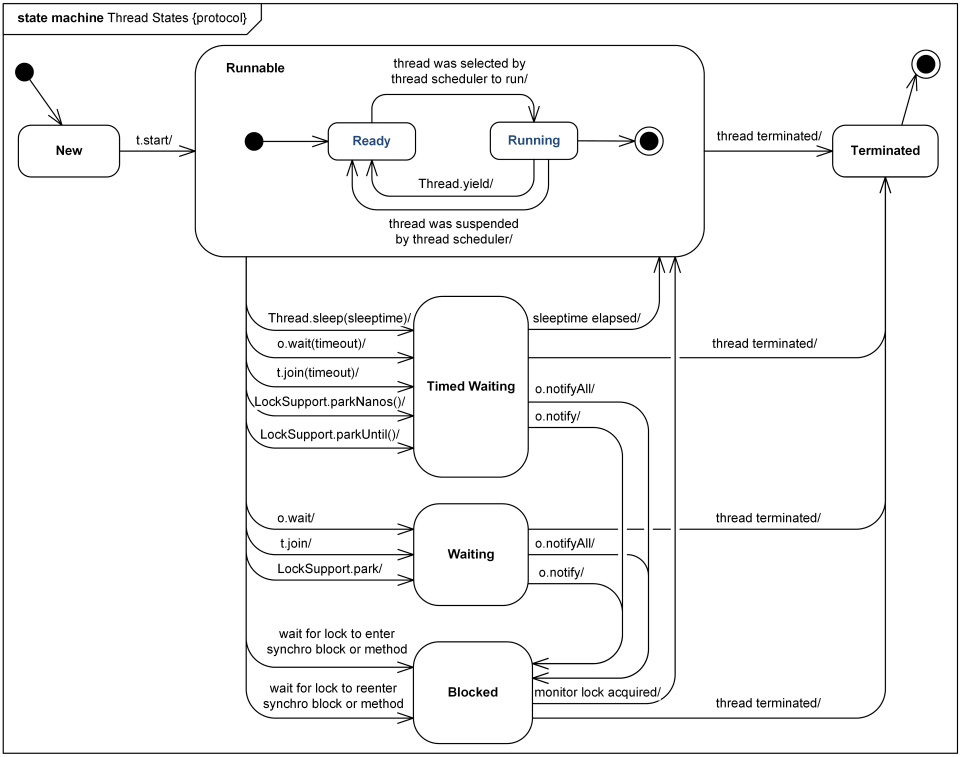
Java Concurrency: Thread State
In Java, a thread has 5 kinds of states: NEW, RUNNABLE, BLOCKED, WAITING, TIMED_WAITING, TERMINATED. When you execute Thread.sleep(long), the current thread status will transform from RUNNABLE to TIMED_WAITING, and the current thread will give up CPU resources to another threads. But the current thread will not give up the monitor.
When execute Object.wait(), the current thread will become to WAITING state ( Object timed wait will make thread to TIMED_WAITING state ). But different with Thread.sleep(), Object.wait() will make thread to give up the monitor.
When your code use synchronized keyword try to acquire a monitor but blocked, the current thread will be at BLOCKED state. At that moment, the thread cannot respond to the interruption. But at WAITING and TIMED_WAITING state, a thread can have chance to respond to the interruption.
Different with synchronized, Lock.tryLock(long time, TimeUnit unit) can respond to the interruption. So use Lock in Java 5 concurrent is a way to avoid dead lock.
Friday, January 18, 2013
Next stop - Spring 4.0
Spring will reach to 4.0 at the end of 2013. One of highlight features is new features of Java SE 8.0 and Java EE 7.0 will be supported. Included Lambda, JSR310 Date and Time, JMS 2.0, JPA 2.1, Bean Validation 1.1, Servlet 3.1, JCache and JSR356 WebSocket support. Another highlight feature is you will be able to write Spring configuration with Groovy-style.
Thursday, January 17, 2013
Preserve Whole Object
And this refactoring (Preserve Whole Object) can also improve the readability.
And when you apply "Preserve Whole Object", you find the invoked method need a lot of attributes of this object. You need to consider use "Move Method" to do the code refactoring. So "Preserve Whole Object" can help you to know whether your code need to do "Move Method" refactoring.
Friday, January 11, 2013
@Resource, @Inject and @Autowired
@Resource is from JSR250 (Common Annotations for Java), when you write an app on Java EE platform, you can use @Resource to get reference from the container, like DataSource or SipFactory (from Sip Servlet) or something else you defined in your container. @Inject, it totally for DI, from JSR330 (Dependency Injection for Java). In Spring application, @Reource and @Inject and @Autowired are similar, but out of Spring, it will be another story.
Tuesday, January 8, 2013
Spring Migration Analyzer
If you want to migrate your application from JavaEE platform to Spring platform, you can use Spring Migration Analyzer to scan your app then get a suggestion report. The input of this tool is the byte package of your app, not the source package. And when you use SMA, you have to configure it. For example, you should tell SMA to exclude dependent jars of your project.
For more information, go to SpringSource.org
Wednesday, January 2, 2013
How to run Tomcat7 Maven plugin
Yesterday when I studied Spring MVC showcase I found if you run "mvn tomcat:run", the async samples would not be successful. When I checked "pom.xml", I found it used old version Tomcat Maven plugin.
Loading ....
Then I change it to latest Tomcat Maven plugin. The artifact id is tomcat7-maven-plugin. (You can get it on search.maven.org, so I will not show the code.). Then run "mvn tomcat:run", but still failed. I found this plugin still use Tomcat6, not Tomcat7. Later, I tried "mvn tomcat7:run". Then I found this time the plugin used Tomcat7 run the application. So when you use Tomcat7 Maven plugin, you have to run "mvn tomcat7:run".
Monday, December 31, 2012
Spring Java-based configuration
From Spring 3.0, we can configure our Spring application with a new way: Java-based configuration. With Java-based configuration, you can migrate all XML configuration files to configuration Java class. With that, you can avoid typing errors and enjoy the programmatic features. Though some IDEs, like Intellij IDEA can make you away from typing errors, but with Java-based configuration, you can enjoy this feature on all of IDEs, even with text editors.
In my opinion, Spring configuration best practice is use Annotation configure your own code. For 3rd party classes, Java-based configuration is a good choice.
The following are some samples from Spring 3.0 Documentation.
XML-based configuration load Java-based configurationJava-based configuration load XML-based configuration
Specifying bean scope
Saturday, January 17, 2009
An Demo App Developed with Grails
This demo app simulates the "Booking" example in Seam Framework, but developed with Grails, an all-in-one framework based on Spring, Hibernate and Sitemesh. Grails is inspired by ROR but more powerful because the supports of Java frameworks and Groovy.
You can find the source code in Google Code's SVN. Anyone interested in Groovy, Grails and Seam can communicate with me.
The next step plan is to rewrite the 'seambay' example of Seam Framework in Grails.
You can find the source code in Google Code's SVN. Anyone interested in Groovy, Grails and Seam can communicate with me.
The next step plan is to rewrite the 'seambay' example of Seam Framework in Grails.
Subscribe to:
Posts (Atom)